
If your lower back pain keeps returning, the cause may involve the lumbar muscles, intervertebral discs, facet joints, or irritated nerve roots. You can often start with home care, then progress to physical therapy, medication, or minimally invasive procedures based on how your symptoms behave. The right treatment depends on what’s driving the pain, and some common approaches help more than others.
Key Takeaways
- Start with home care: gentle stretching, neutral-spine posture, and ice or heat based on whether pain is newly irritated or muscularly tight.
- Physical therapy can reduce pain through targeted strengthening, posture training, manual therapy, and graded loading of the back and hips.
- Medications such as NSAIDs, acetaminophen, muscle relaxants, or certain nerve-pain drugs may help, depending on the pain source.
- Complementary options like acupuncture, mindfulness, and ergonomic changes may improve symptoms when combined with exercise-based treatment.
- If symptoms persist or include weakness, sciatica, or bowel/bladder changes, evaluation for injections or surgery may be necessary.
What Causes Persistent Lower Back Pain?
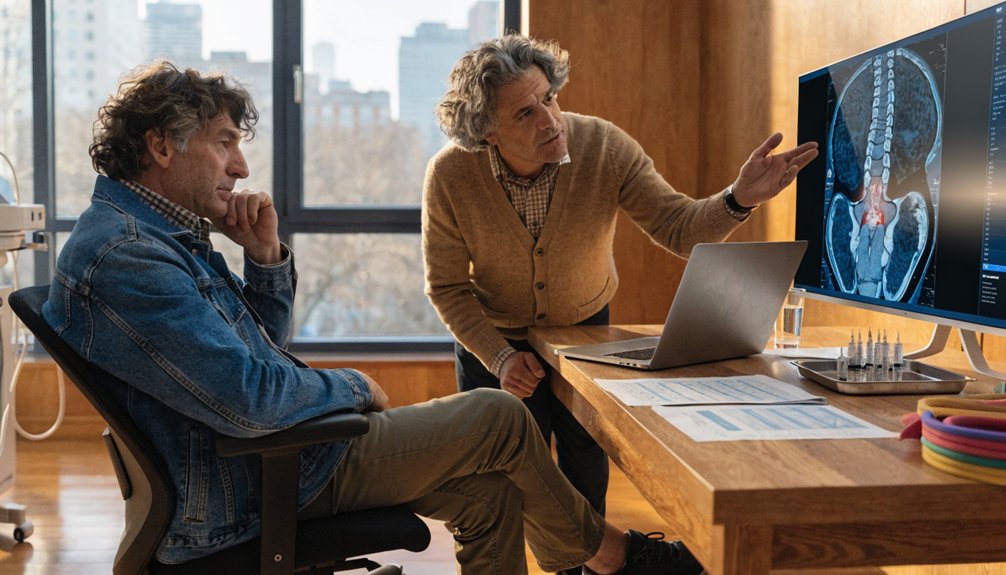
Although persistent lower back pain may seem to come from a single spot, it often develops from several structures in the lumbar spine working under ongoing strain or irritation. You may have pain from intervertebral discs, facet joints, ligaments, nerve roots, or paraspinal muscles, and each source can produce different patterns of stiffness, aching, or radiating symptoms.
Common contributors include repetitive loading, poor spinal alignment, prior injury, degenerative disc changes, facet arthropathy, and muscle strain. If a disc bulges or annular fibers tear, nearby nerves can become sensitized. Tight hip flexors, weak core stabilizers, and altered movement mechanics may increase compressive forces across lumbar segments. Inflammatory conditions, spinal stenosis, or spondylolisthesis can also sustain symptoms, which is why accurate diagnosis guides targeted treatment and better long-term outcomes. For many people, these issues are compounded by poor physical condition, obesity, smoking, and psychosocial stressors, all of which are known to increase the risk and persistence of low back pain.
Lower Back Pain Treatment at Home
At home, you can often reduce lower back pain with gentle stretching that improves mobility in the lumbar spine, hip flexors, and hamstrings without increasing tissue irritation. You may also get short-term relief by using cold therapy early to limit inflammation and heat later to relax paraspinal muscles and improve circulation. Small posture and activity changes, such as maintaining a neutral spine and avoiding prolonged sitting, can decrease mechanical stress on the lower back and support recovery. Incorporating tailored exercise routines that focus on flexibility and strengthening can further reduce muscle tightness and support long-term lower back health.
Gentle Stretching Routines
When lower back pain flares up, gentle stretching can help reduce muscle guarding, improve mobility in the lumbar spine and hips, and ease stress on nearby joints and soft tissues. You’ll usually tolerate controlled, pain-free movements better than forceful stretches, especially when paraspinal muscles, hip flexors, hamstrings, or the gluteal complex are tight.
Start with pelvic tilts, knees-to-chest, and a supported child’s pose, moving slowly and breathing evenly. If symptoms allow, add supine hamstring stretches and a figure-four stretch to reduce tension that can alter pelvic mechanics. Hold each stretch about 20 to 30 seconds without bouncing. Consistency matters more than intensity, and yoga benefits may include flexibility improvement, better neuromuscular control, and reduced stiffness. Stop if pain radiates, sharpens, or increases afterward considerably.
Heat And Cold Therapy
Alongside gentle stretching, heat and cold therapy can help manage lower back pain at home by targeting different phases of tissue irritation and muscle spasm. Use cold packs during the first 24–48 hours when lumbar paraspinal tissues feel inflamed or swollen; they constrict superficial vessels and dull nociceptive signaling.
Use moist heat after acute irritation settles, especially if your erector spinae feel tight; it improves local blood flow and reduces guarding around the lumbar fascia.
| What you feel | Why it matters |
|---|---|
| Sharp ache | Cold may calm irritated tissues |
| Throbbing stiffness | Heat can ease muscle spasm |
| Fear of moving | Relief helps you breathe easier |
| Lingering soreness | Timed therapy supports comfort |
Limit applications to 15–20 minutes, with a cloth barrier, to protect your skin.
Posture And Activity Changes
Because prolonged flexed sitting and sudden twisting can overload the lumbar discs, facet joints, and paraspinal muscles, small posture and activity changes often reduce pain more effectively than strict bed rest. You should change positions every 30 to 45 minutes, keep your hips level, and support the natural lumbar curve with a rolled towel or chair cushion.
Use ergonomic adjustments at your desk: screen at eye height, feet flat, knees near 90 degrees, and elbows supported. During lifting, hinge at your hips, brace your abdominal wall, and keep objects close to your trunk. When turning, pivot with your feet instead of twisting through your spine. Short walks, gentle extension, and mindful movements help maintain blood flow, reduce stiffness, and prevent deconditioning without aggravating irritated tissues further.
Physical Therapy for Lower Back Pain
Physical therapy can help you reduce lower back pain by using targeted exercise programs that strengthen the lumbar paraspinal muscles, abdominal wall, and hip stabilizers. You’ll also learn how posture and movement patterns affect load across the lumbar spine, sacroiliac joints, and surrounding soft tissues during daily activities. To improve function and comfort, your treatment may also include pain relief techniques such as manual therapy, nerve mobilization, and graded activity. Physical therapists also provide education on body mechanics to help prevent re-injury and support long-term back health.
Targeted Exercise Programs
When lower back pain stems from impaired movement control, deconditioned trunk muscles, or limited hip mobility, a targeted exercise program can reduce pain and improve function by addressing the specific structures and movement patterns involved. You’ll typically start with graded loading to restore lumbar and hip capacity without provoking symptoms.
| Exercise focus | Treatment goal |
|---|---|
| Core stability | Improve segmental spinal support |
| Flexibility training | Restore hip rotation and hamstring length |
Your program may include abdominal bracing, side planks, bird-dogs, glute strengthening, and hip mobility drills. These exercises target the transverse abdominis, multifidus, gluteus medius, and hip rotators, which help offload stressed lumbar tissues. Progression matters: you’ll increase repetitions, resistance, or range only as tolerated, promoting tissue adaptation, endurance, and better daily function over time.
Posture And Movement
Although posture alone usually isn’t the sole cause of lower back pain, the way you sit, bend, lift, and shift between positions can increase compressive or shear load on lumbar discs, facet joints, and surrounding soft tissues.
In physical therapy, you’ll learn ergonomic adjustments that reduce repeated strain during work, driving, and household tasks. Your therapist may retrain hip hinging so your gluteal muscles and hips absorb force instead of your lumbar spine. You’ll also practice mindful movement: keeping loads close, avoiding sustained flexion or rotation, and changing positions before tissues become sensitized. Small modifications, like seat height, foot support, and desk setup, can improve spinal alignment and trunk muscle efficiency. Over time, better movement patterns help distribute forces more evenly across the lumbopelvic region and support lasting functional improvement daily.
Pain Relief Techniques
Better posture and movement habits reduce repeated stress, but physical therapy also uses targeted pain-relief techniques to calm irritated lumbar tissues and make activity more tolerable. Your therapist may apply manual therapy to reduce guarding in the paraspinals, quadratus lumborum, and gluteal muscles while improving motion at the facet joints and sacroiliac region. They may also prescribe heat, ice, or TENS to modulate pain signals and decrease protective muscle spasm.
You’ll often pair these treatments with graded exercise, because pain usually improves when lumbar discs, ligaments, and stabilizing muscles are loaded progressively, not avoided. Some patients also explore acupuncture benefits for short-term symptom reduction. Adding mindfulness practices can lower pain sensitivity, reduce fear-driven bracing, and help you move with better control during daily tasks and exercise sessions.
Medications for Persistent Lower Back Pain
For persistent lower back pain, medication can reduce pain enough to help you stay active and participate in physical therapy, but it usually works best as one part of a broader treatment plan.
- You may start with over the counter options like NSAIDs or acetaminophen.
- NSAIDs can ease inflammation around lumbar joints, discs, and paraspinal tissues.
- If nerve-related pain radiates down your leg, certain antidepressants or anticonvulsants may help.
- Muscle relaxants can briefly reduce spasm, though they often cause drowsiness.
- Ask about opioid alternatives first, because long-term opioids carry dependence and limited functional benefit.
Your clinician should match medication to pain source, duration, kidney or liver risks, and your activity goals. You’ll usually get better results when medication supports exercise, sleep, and movement. A comprehensive plan that combines medication with alternative therapies and physical treatment often leads to more effective, longer-lasting relief.
Minimally Invasive Lower Back Pain Treatments
When medication, exercise, and physical therapy don’t provide enough relief, minimally invasive treatments may target the structures generating pain with less tissue disruption than surgery. If inflamed lumbar nerve roots are driving sciatica, epidural injections can deliver corticosteroid near the epidural space to reduce inflammation and improve short term function. For pain arising from the facet joints, your clinician may use diagnostic medial branch blocks to confirm the source before radiofrequency ablation disrupts pain signaling along those small sensory nerves. Some patients with sacroiliac joint pain may benefit from image guided injections placed directly into the joint capsule. These procedures are typically performed with fluoroscopic or ultrasound guidance, helping your clinician place medication accurately while limiting injury to nearby muscles, ligaments, dura, and spinal nerves. Before progressing to more invasive operations like spinal fusion, many clinicians recommend maximising conservative and minimally invasive options as part of a stepwise approach to managing chronic lower back pain.
When Surgery for Lower Back Pain Makes Sense
Although most episodes of lower back pain improve without an operation, surgery can make sense if imaging and examination identify a structural problem that matches your symptoms and less invasive care hasn’t restored acceptable function. Lumbar disc herniation is far more common than cervical herniation, and large herniations that threaten the cauda equina require immediate surgical decompression to prevent permanent nerve damage.
- You’re among surgical candidates when a disc herniation compresses a nerve root.
- Spinal stenosis causing neurogenic claudication may warrant decompression if walking remains limited.
- Spondylolisthesis or instability can require fusion when vertebral motion provokes pain or deficits.
- Progressive weakness, bowel or bladder dysfunction, or severe numbness need urgent surgical evaluation.
- Ask about procedure goals, complication risks, and recovery expectations before deciding.
You’ll usually need concordant MRI or CT findings, failed physical therapy, medications, or injections, and symptoms that persistently impair work, sleep, mobility, or basic daily activities.
Frequently Asked Questions
Can Stress or Anxiety Make Persistent Lower Back Pain Feel Worse?
Yes, stress or anxiety can worsen your persistent lower back pain by increasing lumbar muscle tension, amplifying nervous system pain signaling, and reducing coping capacity. Stress management and anxiety relief can support more effective symptom control.
How Does Poor Sleep Affect Recovery From Persistent Lower Back Pain?
Poor sleep dims your body’s repair lights: reduced sleep quality heightens lumbar muscle tension, amplifies pain signaling, and slows tissue healing. You’ll often face a longer recovery timeline, so improving sleep supports spinal recovery and function.
Are Ergonomic Office Chairs Worth It for Long-Term Lower Back Pain?
Yes, they’re worth it if you use proper chair adjustments; ergonomic benefits can reduce lumbar flexion, support neutral pelvic alignment, and decrease muscle strain. Still, you’ll need movement breaks and exercise for lasting relief.
Can Persistent Lower Back Pain Impact Sexual Activity or Intimacy?
Like a dimmer switch, yes—persistent lower back pain can reduce sexual activity and create intimacy challenges by aggravating lumbar muscles, facet joints, or nerves. You’ll benefit from pain management, positioning changes, pacing, and clinician guidance.
When Should I See a Pain Specialist Instead of a Primary Doctor?
You should see a pain specialist when your chronic pain lasts over 6–12 weeks, worsens, or includes nerve-related leg symptoms, weakness, or numbness. Your primary doctor usually starts the referral process after conservative spine treatments fail.