
If you want a back-friendly fitness routine, start by matching exercise to your current mobility, strength, and symptom pattern. Research supports low-load, tolerable movement, especially when you build trunk stability, hip strength, and thoracic mobility without provoking sharp or lasting pain. You don’t need to avoid training; you need better exercise selection and progression. The key is knowing which movements protect your spine and which ones quietly add stress.
Key Takeaways
- Start with low-load, tolerable movements that match your mobility and symptoms, and seek medical evaluation for persistent or worsening pain.
- Choose exercises that build spinal stability, hip mobility, and trunk endurance, such as walking, supported hinging, step-ups, and controlled mobility drills.
- Strengthen core and glutes with bracing and anti-rotation exercises like dead bugs, bird dogs, bridges, and clamshells.
- Improve hip and thoracic mobility with controlled stretches, rotations, and daily posture-aware movement breaks instead of forcing lumbar flexibility.
- Progress slowly by changing one training variable at a time, and stop movements causing sharp, radiating, or lingering pain.
How to Start a Back Friendly Routine Safely
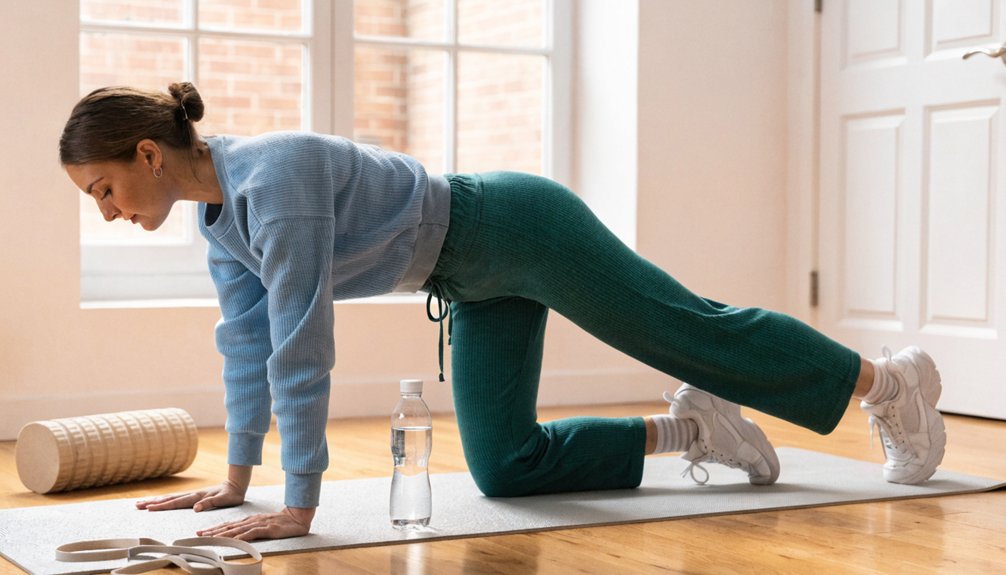
Before you begin a back-friendly fitness routine, it’s important to make sure your starting point matches your current mobility, strength, and symptom pattern. You’ll want to note when discomfort appears, whether it centralizes or radiates, and how your lumbar spine, hips, and thoracic region move during daily tasks. Start with low-load activity you can tolerate consistently, not what you think you should handle. Use posture awareness to keep your rib cage, pelvis, and neck aligned without rigid bracing. Monitor intensity, duration, and recovery for 24 hours after each session. If symptoms spike, scale back. Gradual progression matters because spinal tissues, supporting musculature, and motor control adapt over time, not instantly. If pain is persistent, progressive, or accompanied by numbness, weakness, or bowel or bladder changes, seek medical evaluation promptly. Consistency with targeted exercise and movement is essential for long-term back pain prevention and resilience.
Choose Exercises That Help, Not Hurt, Your Back
Because your back responds best to movement that builds support without provoking symptoms, choose exercises that reinforce spinal stability, hip mobility, and trunk endurance rather than drills that repeatedly force painful flexion, extension, or rotation. Favor walking, supported hinging, step-ups, carries, and controlled mobility work that lets you maintain proper posture and neutral alignment through the lumbar spine and pelvis. Integrating physical therapy exercises that emphasize stretching, strengthening, and posture training can further reduce pain and support long-term back health. You should stop or scale any movement that reproduces sharp, radiating, or lingering pain, especially under load or fatigue. Instead of chasing range, prioritize symptom-free motion, steady breathing, and tempo you can control. Smart exercise modifications, such as reducing depth, using support, or limiting rotation, lower tissue stress while preserving training effect. If an exercise feels better during and after you do it, that’s usually a useful sign.
Strengthen Your Core and Glutes for Stability
Build stability from the center out: your core and glutes help control how force moves through the pelvis, hips, and lumbar spine during everyday lifting, walking, and exercise. When these muscles do their job, your spine doesn’t have to compensate with excessive motion or muscular guarding. Prioritize core exercises that train bracing and anti-rotation, such as dead bugs, bird dogs, and side planks. These patterns improve trunk stiffness without repeated spinal bending. Pair them with glute activation drills like bridges, clamshells, and controlled step-ups to support hip extension and pelvic control. Focus on alignment: ribs stacked over pelvis, neutral lumbar position, and smooth breathing. Start with low load and perfect form, then progress gradually. If an exercise increases back pain during or after training, scale it back accordingly. For added support, consider integrating tailored exercises and stretching—like cat and sphinx poses—designed to enhance flexibility and provide long-term relief from lower back pain.
Improve Mobility Without Straining Your Spine

Once your core and glutes are providing better support, mobility work can target the joints that should move most—primarily the hips and thoracic spine—so your lumbar spine isn’t asked to create range it doesn’t tolerate well. Use dynamic stretching and controlled rotations, keeping posture awareness so movement comes from hips, rib cage, and shoulders, not your low back. Integrating brief movement breaks and ergonomic posture habits throughout the day supports spinal alignment and reduces the strain that can accumulate between workouts.
| Area | Drill | Cue |
|---|---|---|
| Hips | 90/90 switches | Rotate from hips |
| T-spine | Open books | Keep pelvis quiet |
| Ankles | Knee-to-wall | Heel stays down |
Move slowly, breathe fully, and stop before pain, pinching, or compensations appear. You’re aiming to restore usable motion, not force flexibility. That approach improves mechanics for walking, squatting, reaching, and daily tasks while reducing unnecessary spinal stress and protecting sensitized tissues and joints.
Increase Intensity Without Hurting Your Back
As your movement quality improves, you can raise training demand by changing one variable at a time—load, range of motion, tempo, volume, or instability—so your spine can adapt without being overloaded. Use progressive overload gradually, keeping your rib cage stacked over your pelvis and maintaining neutral lumbar mechanics under fatigue. You don’t need maximal weights; you need repeatable, well-controlled reps that respect tissue tolerance and pain management. Integrating principles from personalized care strategies used in chronic back pain management—such as gradual progression, posture correction, and regular reassessment—can further reduce risk as you increase training intensity.
- Increase only one training variable weekly, not several together.
- Stop sharp, radiating, or escalating pain; soreness is different.
- Brace through the abdominal wall, diaphragm, and pelvic floor together.
- Prioritize hip hinge and glute drive to reduce lumbar shear.
If symptoms linger beyond 24 hours, scale back intensity, shorten range, or reduce volume before progressing again. Track patterns carefully.